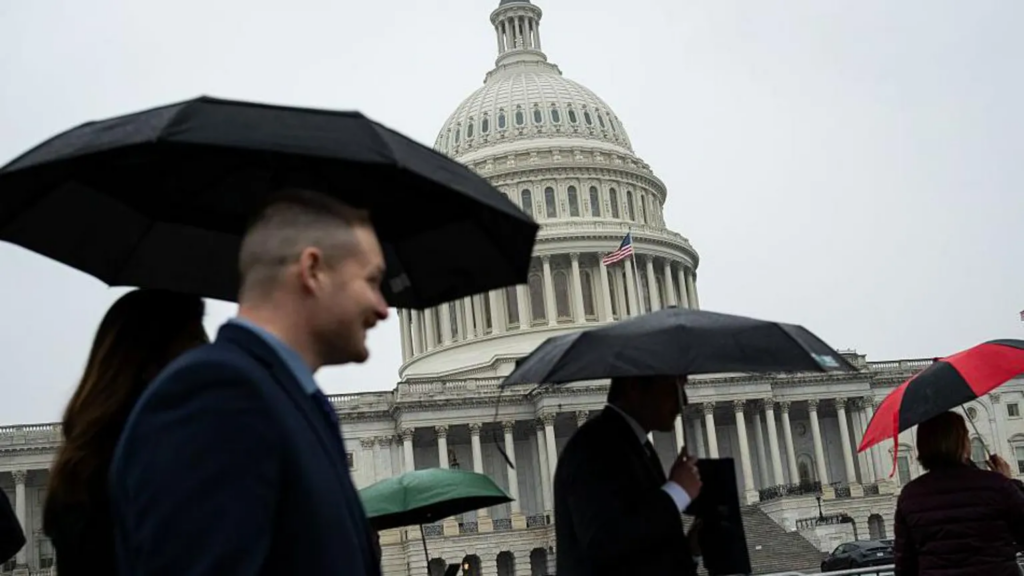
An election-day poll says the economy and the state of democracy are the top issues for US voters. The survey – officially called the Voter Poll – asks tens of thousands of the American electorate their opinions and motivations, and provides a breakdown by age, gender, education and other demographics. Polling company SSRS collects data on behalf of a consortium of news companies, and the survey uses a representative sample of American voters in the run-up to the election, including exit polls of both early and on-the-day voters. Here are some of the breakdowns from the 2026 voter poll. Like all surveys, they are estimates, and the numbers will likely be updated as more data arrives. Economy ranked as top issue Some 39% of those asked in the poll of more than 79,000 people said the economy was the most important issue, while 32% put the state of democracy first. Next, 14% of voters named immigration as most important, while healthcare, foreign policy, and crime ranked lower. The data suggest most US voters have a negative view of the national economy. Some 75% said the economy was in a “not so good or poor” state, while 25% said it was “excellent or good”. Looking at their own family finances, 44% said they were in a worse situation than two years ago, 38% about the same, and 18% better. Majority say Trump’s policies ‘worsened economy’ Almost two-thirds (65%) of voters surveyed say US President Donald Trump’s policies have worsened economic conditions in the US. By contrast, 27% say Trump’s policies have improved conditions and only 8% say the president has had no impact. People were also asked whether expressing support or opposition for Trump was one reason for their midterm vote. About 43% said expressing opposition was a reason, but a similar share (41%) said he was not a factor. Only 16% of those asked said expressing support was a reason for their vote. Voters unhappy with state of the US Almost four in ten (38%) said they were angry about the way things are going in the US at the moment, with another 37% saying they were dissatisfied. Only 18% said they were satisfied, and 7% were enthusiastic. Taken together, a majority told pollsters SSRS they are not happy with the country’s current state. Separately, a large majority, 90%, also said that government corruption was a crucial or major factor in their vote. Inflation has caused hardship for most Americans Beyond broader issues, pollsters also asked about inflation and the impact of rising prices on people’s lives. Almost eight in 10 voters (79%) said inflation had caused them and their family a severe or moderate hardship in the past year. A fifth (21%) said it caused them no hardship at all. A majority of voters (59%) said they were “very concerned” about the cost of petrol and diesel, and a similar proportion (58%) said the same about the cost of food and groceries. More than six in 10 respondents (62%) said they thought higher-than-usual prices were more because of Trump’s policies. And 38% said it was more due to factors beyond his control. Majority say US ‘made wrong decision on Iran’ The voter poll also said that around six in 10 (63%) of those asked said the US made the wrong decision to take military action against Iran. Almost four in 10 (37%) said it was right. Separately, three-quarters of voters (74%) said the conflict was a crucial or major factor in their vote for Congress and a quarter (26%) said it was a minor factor or not a factor. Voting patterns differ by age and gender The voter poll offers insight into how different voter groups cast their ballots. Nationally, the data suggests women backed Democratic candidates for the House at 58%, compared with 40% for Republicans. Men appear to be divided, with just under half voting for each party. By age, almost two-thirds of people aged under 45 said they voted Democrat. The middle-aged group, 45-64, backed Democrats by 51% to Republicans’ 47%. Slightly more than half of those aged 65 and older voted Republican, and 48% voted Democratic. White voters have voted Republican by 51% to Democrat by 48%, according to estimates. All other groups have voted more for Democratic candidates, with Hispanic and Latino voters breaking for them by an estimated 62% compared to 35% for Republicans. Voters without a college education voted more Republican in this election, 51% to 47% Democrat, the survey suggested. People with a college degree have voted Democrat by an estimated 62% to 36% Republican. These numbers reflect the national picture; voting patterns will vary by state.
An election-day poll says the economy and the state of democracy are the top issues for US voters. The survey – of


Comments