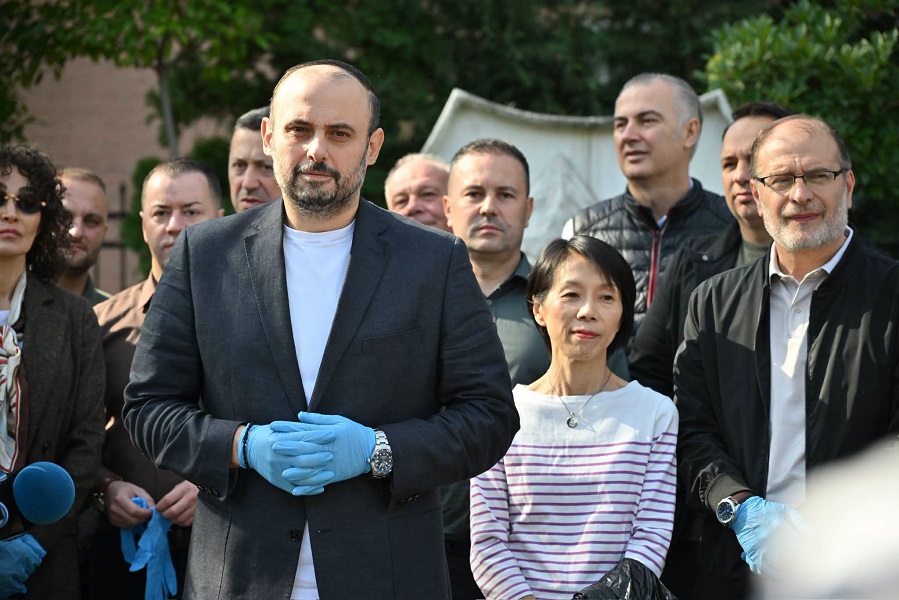
October the 28th, 2026 – Over 100,000 Croatian landlords who rent out their properties to tourists turned their backs on protesters fighting for their rights in Zagreb, but why? The recent protest by private landlords held at Zrinjevac in Zagreb once again opened key questions about representation, expertise and the future of private accommodation in Croatia. Morski reports that although the organisers’ communication channels were burning with announcements of a mass turnout and a blockade of the capital, digital engagement analytics and sociological parameters indicated in advance the modest reach of the gathering. Despite the protest platform on social media gathering around 15,000 followers, the rate of active interaction at the peak of the campaign barely reached 10 percent. When these figures are run through the usual conversion rates to physical turnout, the final outcome on Zrinjevac brought only a few hundred people, a number comparable to a larger group of mushroom pickers rather than a serious national protest. This modest turnout confronted the organisers with the relentless mathematical reality. Application of the sociological model of the Law of Dispersion of the Passive Majority clearly shows that in moments of major legislative upheavals the vast majority of affected actors consciously choose passivity and distance themselves from reactive groups. In this case, support from as many as 105,000 Croatian private landlords was absent from the public uproar. The silent majority, which avoids street activism, thereby sent a clear message that it rejects street pressure and demands institutional strength, expertise and well-founded arguments. a hidden internal division… The relatively weak turnout is also a direct consequence of a completely failed communication model. The use of populist rhetoric permeated with expressions about “serfs”, “cash machines” and accusations of a “witch hunt”, along with bizarre political constructions about secret coalitions and open threats of electoral votes from the podium, disqualified the organisers from serious professional dialogue. Serious professional associations do not negotiate with the authorities through street blackmail, but with exact indicators, legal analyses and constructive proposals. Additionally, the protest revealed a deep, though publicly unspoken, socio-economic stratification within the sector itself. Namely, around 43,000 high-category facilities with 4 and 5 stars, in which significant funds have been invested, attract guests of higher purchasing power and naturally no longer share the same interests with the rest of the base that persists with the basic 3-star model. Nevertheless, owners of higher-quality accommodation, for pragmatic reasons and the desire to preserve good-neighbourly relations in local communities, choose complete passivity, leaving the protest margins to the loudest groups. are amendments making landlords kick the can down the road? On the other hand, uncertainty on the ground has been further heightened by the fact that the Government and the Ministry of Tourism and Sport (MINTS) have, through months of administrative silence, delayed precise clarifications of the new legislative amendments and the announced re-categorisation. This created information vacuum has served as fuel for the spread of panic, although it is clear that the state does not want to wipe out private accommodation, but to introduce necessary regulatory order and balance the interests of landlords with the remaining 90 percent of people. It is also expected that expert teams will take a sharper approach towards non-commercial accommodation which, under the guise of hosting, often represents a source of unfair competition. Despite the tensions, the financial contribution of private landlords to Croatian tourism remains extremely significant. On the basis of around 600,000 registered beds, landlords through the fixed lump-sum tourist membership fee of €5.97 per bed generate around €3.58 million annually, while through the lump-sum tourist tax, with a conservative average of €50 per bed, they pay an additional €30 million. As such, more than €33.5 million of original money flows into the budgets and the system of tourist boards every year. a constructive proposal… Instead of directing these funds into ineffective general promotion or spending from the general state budget, a real and sustainable alternative offers the redirection of part of this earmarked pool into a National Programme of Targeted Vouchers for Apartment Transition. Modelled on successful European practices, such as Italian regional micro-grants in Tuscany and Apulia or the French Gîtes de France network, this model would directly help raise the quality of accommodation on the ground. The proposed vouchers would not be distributed in cash nor would they be intended for high-category 4- and 5-star facilities that already operate well. They would be used exclusively for co-financing the costs of interior modernisation and the purchase of equipment in 3-star facilities that demonstrably move into a higher category. Functioning as closed instruments intended for payment of works to registered domestic craftsmen and companies and for the purchase of equipment in Croatian shops, these millions would return directly into the entire Croatian economy, turning fiscal contributions into a driving force of sustainable market evolution. The post Why Did Over 100,000 Croatian Landlords Turn Their Backs on Protesters? appeared first on Total Croatia .
The recent protest by private landlords held at Zrinjevac in Zagreb once again opened key questions about representation




Comments