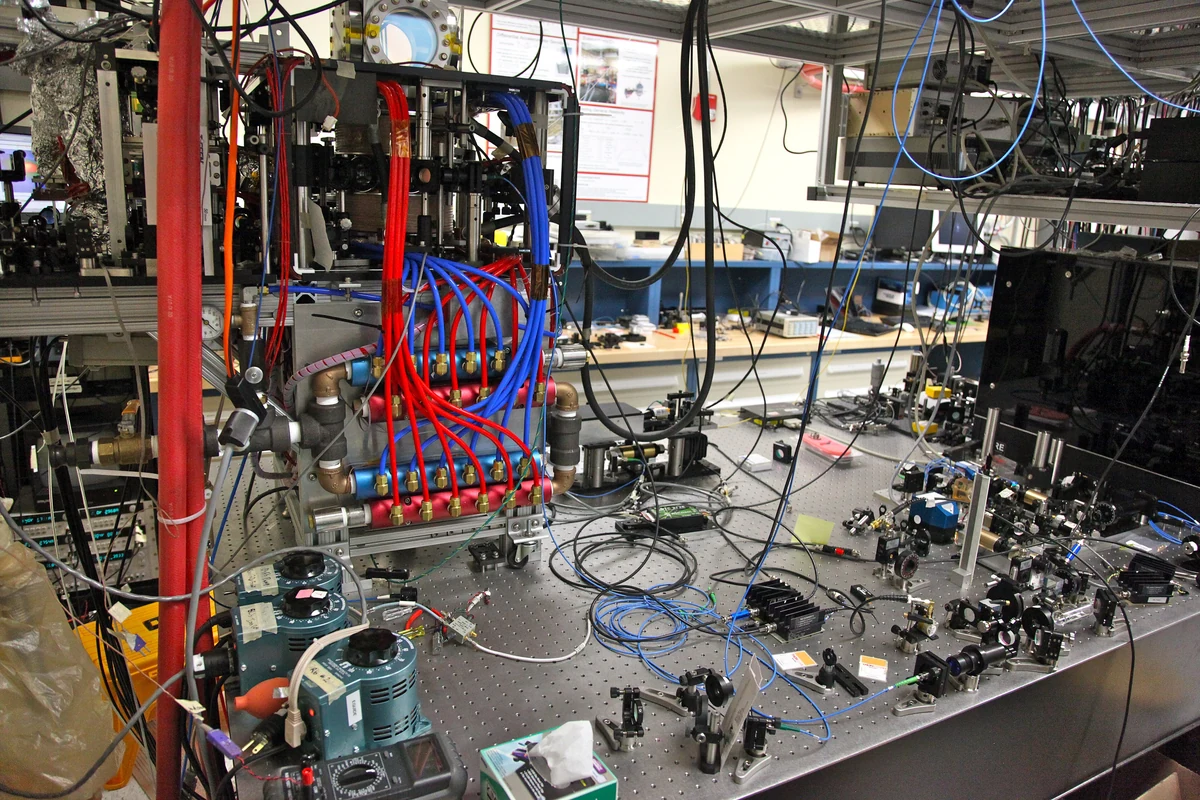
On November 6 a paper in Science moved the low-temperature record again: an ultracold-atom physics rack inside the Mengtian module of China's space station cooled a cloud of rubidium atoms to an effective temperature of 9.7 picokelvin, roughly fourteen orders of magnitude below room temperature, and kept the cloud observable for about seven seconds. The previous comparable benchmark, set by a German group in 2021, was 38 picokelvin.
Translate the number first. One picokelvin is a trillionth of a kelvin, and absolute zero sits at minus 273.15 degrees Celsius. This cloud sits less than ten trillionths of a degree above the theoretical floor. That is not merely cold: thermal motion has been quieted so thoroughly that quantum behaviour stops being a microscopic correction and becomes a macroscopic object you can hold, tune and measure.
Why go to orbit at all? Gravity is the answer. On Earth, cold atoms fall out of their trap unless a strong magnetic or optical field clamps them in place, and a tight clamp stirs them, heats them and shortens their lifetime. In microgravity the atoms float almost free, so a very weak potential suffices — weaker confinement means lower temperatures and longer observation windows. Seven seconds is a luxurious amount of time in this field.
The chosen technique matters too. Instead of the magnetic traps common in earlier experiments, the team used an all-optical approach: a magneto-optical trap and optical molasses for initial cooling, then a two-stage crossed optical trap for deep cooling. Lowering the light intensity drives evaporative cooling — the energetic atoms escape, the ones left behind are colder — and a final non-adiabatic diffusion stage pushes the ensemble into the picokelvin regime.
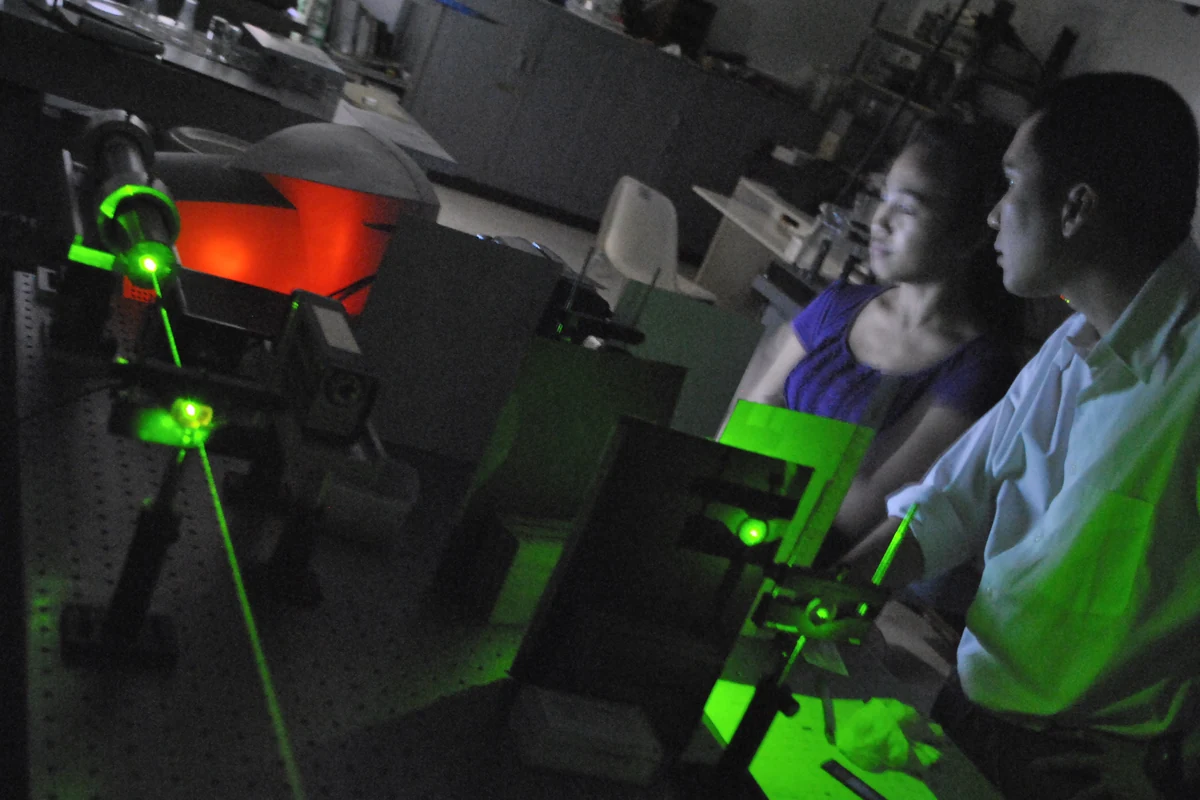
Optical traps are harder to build than magnetic ones, but they buy three things: more usable optical channels, insensitivity to magnetic interference, and compatibility with a wider range of quantum-simulation protocols. For a cabinet that must run for years in orbit with no technician able to open the lid, engineering reliability and scientific flexibility are worth more than a single record.
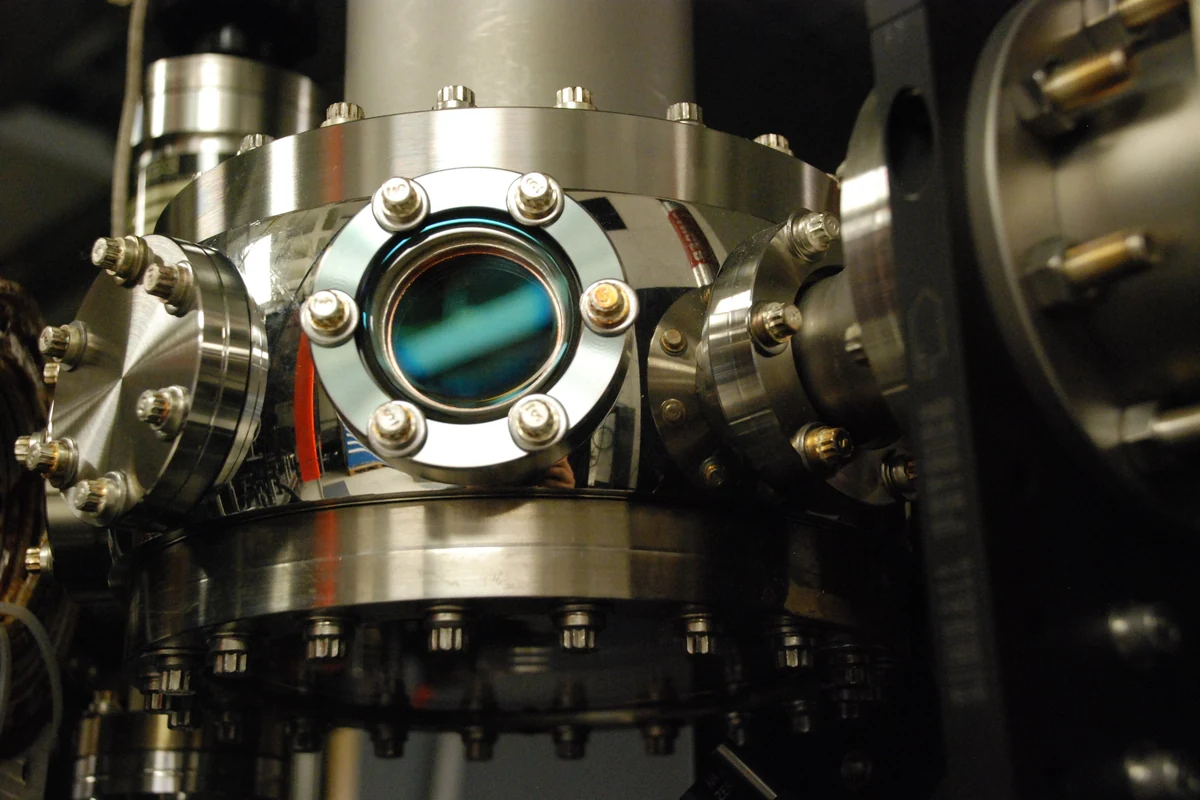
The integration is arguably the most impressive part. A comparable ground-based ultracold-atom system occupies about 20 cubic metres and weighs 10 tonnes; the flight version fits into 0.7 cubic metres and 0.5 tonnes. That required an extreme-high-vacuum system, high-power fibre lasers, continuous long-term laser frequency stabilisation and a precision integrated optical bench. The project was proposed in 2011, launched in 2022, and produced this result fifteen years later.
Reviewers for Science called the work a milestone in precision control of ultracold atoms, valuable both for fundamental physics and for applications such as space navigation and Earth observation. Note what they praised: not the thermometer reading, but the fact that this control capability can now be carried somewhere and reused.
What is it good for? The first answer is quantum simulation. With thermal noise suppressed almost to zero, the atoms become a clean, tunable model for many-body problems that are intractable in real materials — phase transitions in ultracold quantum gases, non-equilibrium dynamics, many-body correlations, even analogues of early-universe physics and proposals to detect ultralight dark matter. All of them need a pristine test bed.
The second answer is precision measurement. Colder, slower atoms make better interferometer probes: optical atomic clocks, atom-interferometric inertial sensing, mapping Earth's gravity field and tests of fundamental constants all depend on exquisite control of atomic motion. A space station is itself a long-duration microgravity platform, so putting the cold-atom lab there places the instrument right next to the phenomenon it measures.
There is a quiet methodological reversal here. For a century, extreme conditions were pursued by building bigger machines and stronger fields. This result came from subtracting interference: no strong magnetic clamp, no brute-force confinement, just an environment that removes the dominant disturbance. Sometimes the subtraction goes further than the addition.
The industrial spillover will arrive earlier than the science. Long-term frequency-stabilised lasers, vacuum systems that survive years in orbit, remote automated control, optical structures that endure launch vibration — each is a shared foundation for high-end precision instruments. History says the first technology to reach the market is rarely the scientific goal; it is the engineering that had to grow up to serve it.
Seven seconds should not be mythologised either. It is much longer than previous comparable runs, but still far from an on-demand reservoir of quantum matter. An effective temperature is not absolute rest for every atom, and sample size, repeatability and compatibility with other atomic species will each take further papers to settle. A record raises the ceiling; it does not close the subject.
When lasers appeared in the 1960s nobody predicted barcode scanners or fibre backbones; when the first Bose-Einstein condensate was made in 1995 nobody connected it to navigation satellites. A rubidium cloud floating in low Earth orbit, nine point seven trillionths of a degree above the floor, is very likely the opening scene of the same kind of story. The honest measure of a fundamental result is not what it can do today, but how many previously impossible experiments it puts on tomorrow's schedule.


Comments