First, an important boundary: nobody found dinosaur blood, and this is not a prologue to resurrecting anything. What was detected are chemical traces of molecules such as heme, plus microscopic structures whose shape survived after minerals took their place. The cellular components of blood start breaking down within days of death. What can cross a hundred million years is a handful of unusually stable molecular frameworks, together with the information carried by where they were sealed.
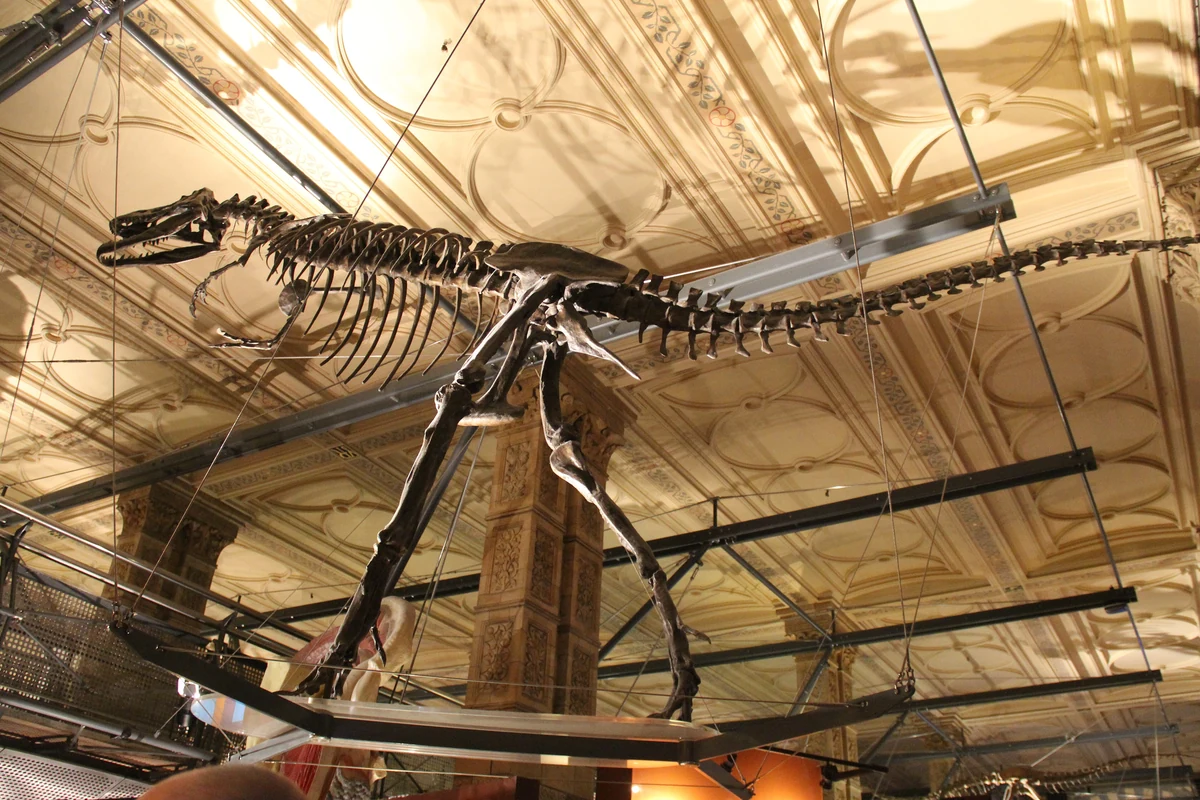
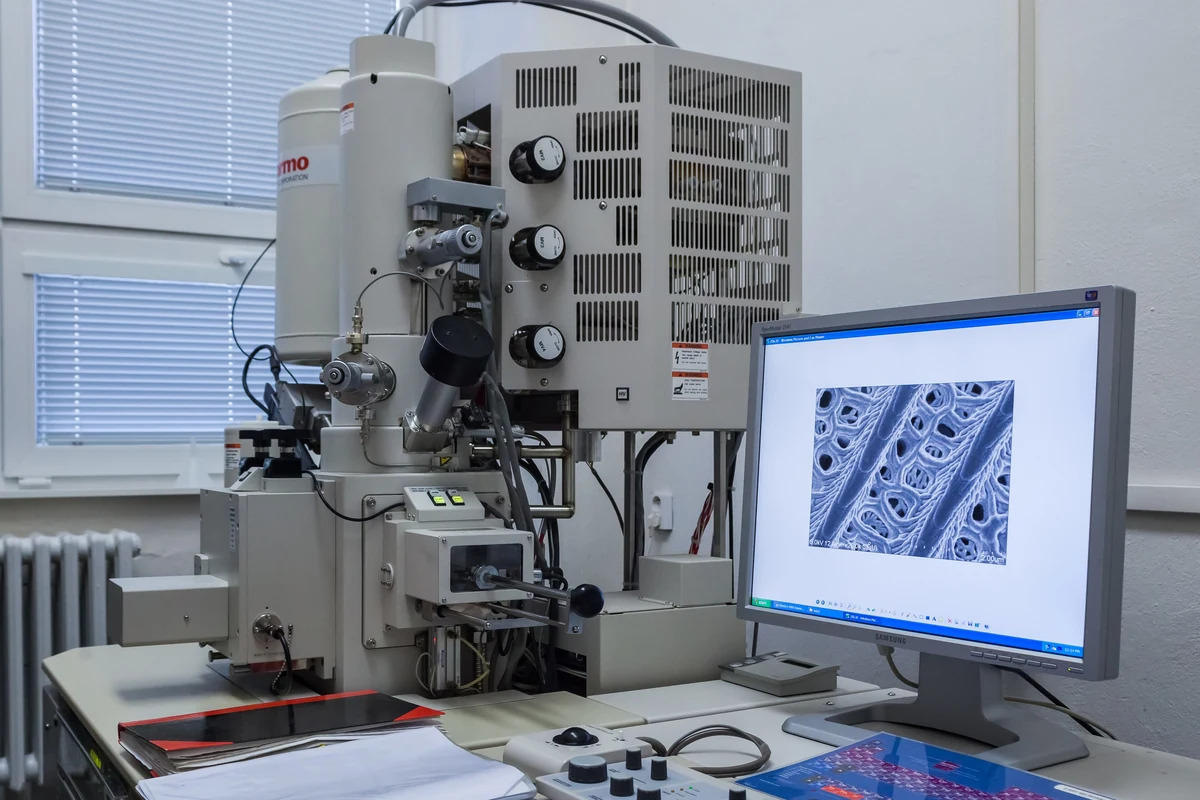
The specimen comes from the Romualdo Formation in north-eastern Brazil, a site famous for exquisitely preserved fish, turtles and pterosaurs but sparse in dinosaur material. It belongs to Aratasaurus museunacionali, a small feathered theropod roughly three metres long that lived around 115 million years ago. The team worked with an exceptionally well-preserved partial hind limb, cut thin cross-sections and examined the bone interior by scanning electron microscopy.
What they saw sat inside vascular canals — the tiny passages that carried blood vessels in the living animal. That location matters more than the shape does. Had the ovals been scattered across surfaces or cracks, later mineral infiltration would be the obvious explanation. Finding them concentrated in the canals while the surrounding sediment contains none weakens the contamination story considerably. Position is itself a piece of evidence.
Then comes chemistry. Elemental mapping showed the ellipsoids rich in iron, carbon and nitrogen, matching the composition of heme. Laser-scattering analysis pointed to porphyrins, the ring-shaped organic compounds that precede and derive from heme. The team also separated and identified the contents of a bone extract specifically to exclude porphyrins from plant sources such as chlorophyll. Amino acids associated with collagen turned up as well.
So why did any of it survive? The paper points to a manganese oxide mineral called hausmannite, found inside the oval structures. It appears to have acted as a time capsule during fossilisation: filling, stabilising and then entombing the residual organic molecules before oxidation and hydrolysis could finish them off. The researchers also suspect rapid burial in sediment, an oxygen-poor setting and a covering microbial mat all helped slow decay at the very beginning.
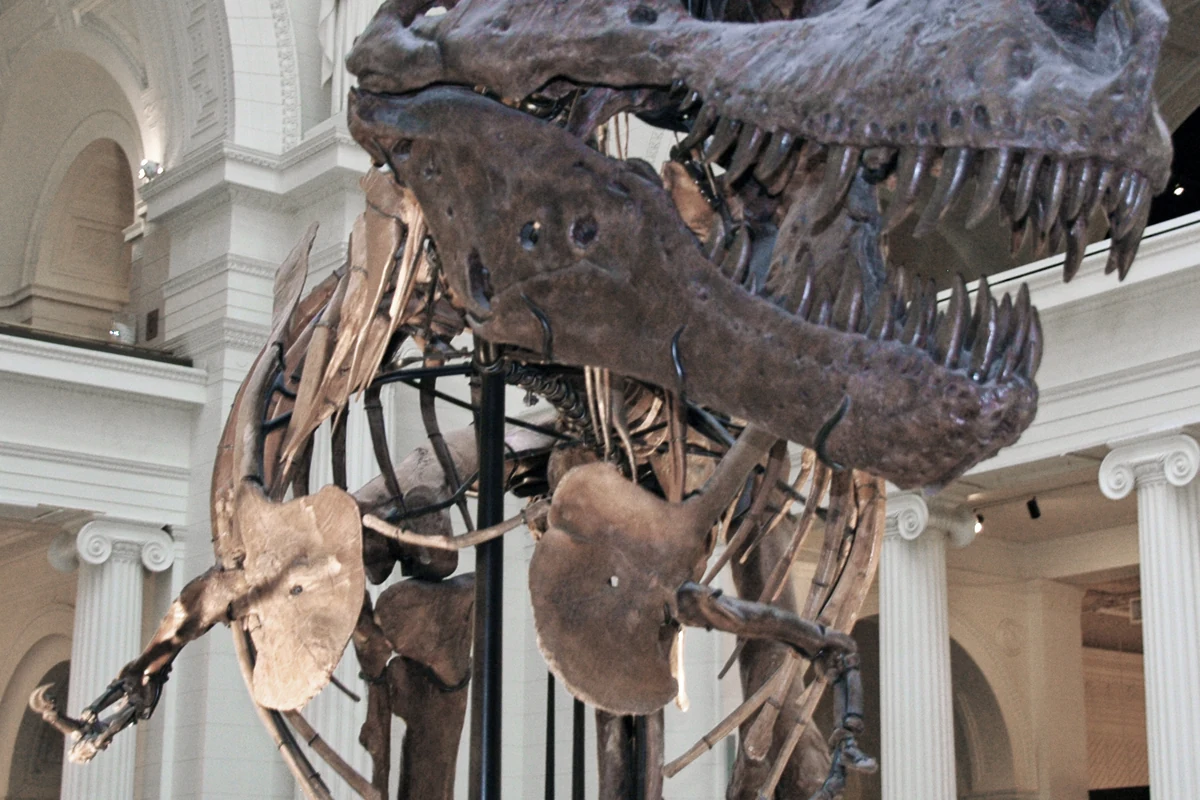
That explanation is necessary because paleontology carries a famous cautionary tale. In 1997 two researchers re-examined tiny spheres once celebrated as fossilised red blood cells and showed they were actually pyrite deposited in the bone after death. Minerals growing during fossilisation can mimic living structures with unnerving accuracy. The resulting informal rule was that a blood-cell claim needs both a morphological comparison with living relatives and identifiable biomarkers — looking similar is not enough.
This study is explicitly answering that rule. The authors emphasise that they supply shape, anatomical location, elemental composition and molecular signals together, and they argue hausmannite did not simply occupy a hollow left behind by decayed tissue, but actively helped stabilise and protect what remained of it. The centre of the argument shifts from resemblance to mechanism, which is a firmer methodological footing than was available two decades ago.
The disagreement did not disappear, though. A molecular paleontologist not involved in the work said publicly that the images do not yet convince her: red blood cells in living birds and reptiles retain a nucleus and show a distinct bulge, whereas these structures appear concave and smaller than most non-mammalian red blood cells. She praised the stacking of multiple analytical techniques and still called the work an exciting advance.
That kind of split is healthy, and it marks the boundary of the claim: everything rests on one specimen from one animal. Establishing a general phenomenon rather than an extraordinary outlier requires other teams to reproduce comparable results in equivalent formations and in different museum collections. A single fossil can raise a strong possibility; it cannot carry a general rule on its own.
Another phrase worth handling carefully is how long biomolecules can last. The assumption being overturned is a textbook default — that hemoglobin-derived molecules could not persist across deep time — not a discovery that these molecules acquired special powers. The accurate formulation is conditional: under a particular combination of minerals and burial conditions, detectable molecular signatures may be retained. The conditions are the subject of the sentence.
If the pathway holds up, two fields feel it. Molecular paleontology gains a possible line of evidence on blood, metabolism and even activity levels — traits almost impossible to reconstruct from bone shape alone. Astrobiology gains a practical prompt: if fragile biosignatures can endure for over a hundred million years in the right mineral setting, then the choice of which rocks to sample and which molecules to assay in extreme environments should broaden accordingly.
There is also a very down-to-earth consequence for museum drawers. Collections worldwide hold enormous numbers of fossils that have been numbered, described morphologically and never examined at molecular resolution. They went untested because the default answer was that nothing would be found. Loosen that default and re-screening old specimens becomes unusually good value. The next step may not be a new dig at all, but a different way of reading an old drawer.
For a general reader, the durable takeaway is not the number 115 million but a habit of judgement. When a startling claim appears, ask how many kinds of evidence support it and whether they are independent; ask whether anyone has proposed an alternative explanation; ask how many specimens were examined. Shape can be forged by minerals, chemical signals can be muddied by contamination, and single findings get revised. Trustworthiness comes from that repeated attempt to poke holes, not from how moving the conclusion sounds.
So the honest headline here is a question rather than an answer: given the right mineral and the right burial conditions, how much information can a body carry forward to the present? Hausmannite offers a candidate mechanism, heme offers a set of signals other labs can check, and colleagues have supplied several objections still to be closed. The remainder belongs to the next batch of specimens and the next set of instruments.
Comments