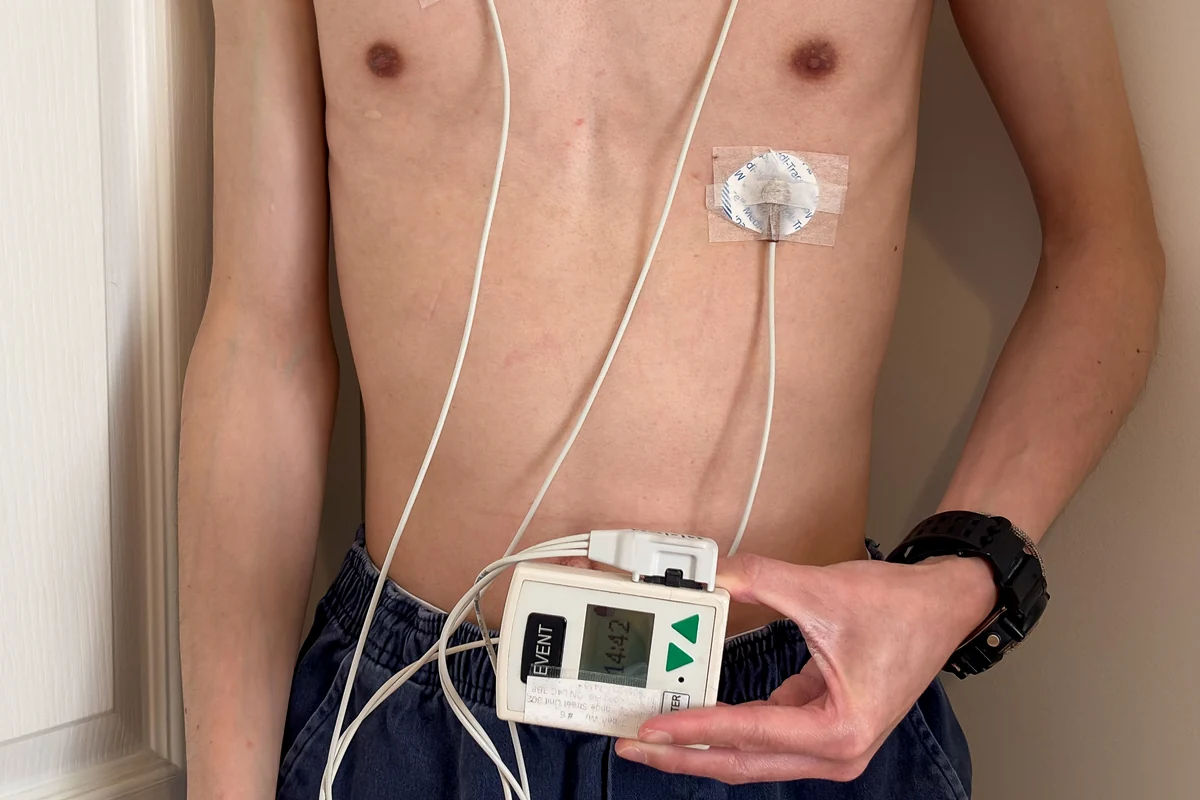
On November 7, a very small object appeared at the import expo in Shanghai: OMRON's wearable ambulatory ECG recorder, the ECG-D01M01. The main unit weighs about 7.8 grams, is roughly 8.5 millimetres thick, and records a continuous ECG for 24 hours while stuck to the chest. Its pitch is deliberately unglamorous — no avatar, no spectacle, just one full day of heartbeats — and that is exactly why it matters.
Atrial fibrillation is among the most common arrhythmias, and its defining nuisance is that it comes and goes. Episodes are paroxysmal, early symptoms are often vague, and a standard resting ECG captures only seconds. If nothing happens during the clinic visit, the report can look perfectly normal. This is why guidance has steadily pushed monitoring windows outward: repeated short recordings, then longer ones, then continuous recording at home.
One widely cited analysis makes the arithmetic blunt. Across 801 arrhythmia cases, only 35 percent were detected within the first 24 hours of wearing a monitor; 65 percent appeared after day one, and seven-day monitoring showed sensitivity roughly 2.3 to 6.5 times that of a single day. Recording duration is not a comfort feature — it sits in the denominator of detection rate. Clinical guidance accordingly recommends, for certain groups, repeated sessions of at least seven days and more than 28 days in total.
Seen through that lens, 7.8 grams is a clinical specification. The lighter and less intrusive the device, the more willing people are to keep it on, and the more complete the real-world dataset becomes. A skin-friendly PU film patch, IP27-rated protection against water and dust, and a peel-and-stick application mean normal activity and even showering can continue. Comfort here is not a nice-to-have; it determines data integrity.
The second hurdle is what happens after the data arrives. An on-board medical-grade eight-category algorithm produces an AI-assisted analysis in about three minutes, and a user who feels unwell can tap a marker in the app, tying a subjective sensation to the exact waveform segment. That mapping is more valuable than it sounds: a clinician's worst problem is rarely too little data, but not knowing which slice corresponds to the moment something felt wrong.
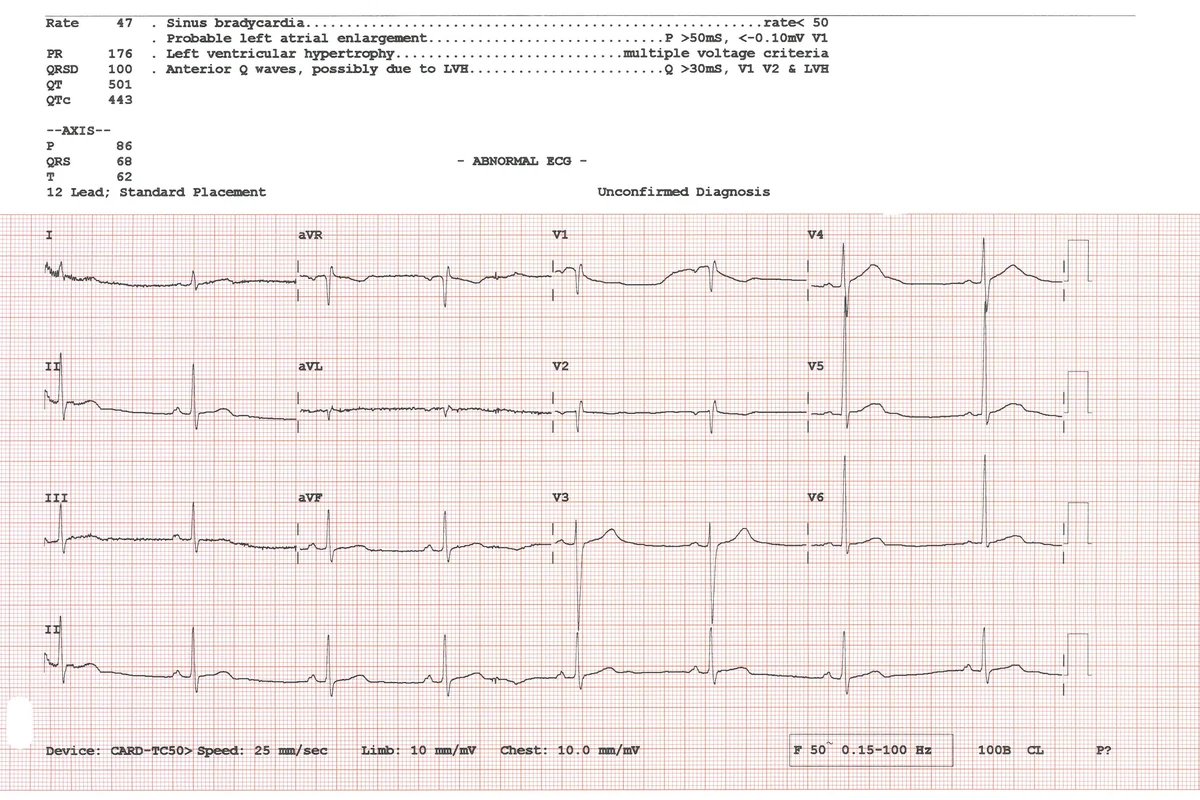
The third hurdle is accountability. At the end of a session the user receives a report reviewed and signed by a licensed physician at a partner tertiary hospital, summarising heart-rate analysis and events such as premature beats or atrial fibrillation. The documentation also states plainly that AI output and monitored data cannot replace clinical diagnosis. Drawing a clear line between screening and diagnosing is worth more than another breathless claim about algorithms.
That collection-analysis-interpretation loop quietly redistributes medical labour. The device carries long-duration signals out of the clinic, the algorithm compresses tens of thousands of beats into suspect segments, and the physician spends attention on the few minutes that require judgement. Only with all three roles doing what they do best does monitoring at population scale become economically plausible.
For the wearables industry this is a change of identity. A decade of wristbands sold step counts and trend lines, comfortably inside consumer electronics. The moment a product emits a structured report for a physician to countersign, it crosses into medical devices and services, where regulatory pathways, quality systems, liability chains and data rules all change. The hardest part of that crossing is not engineering.
Distribution is shifting in parallel. The patch works with OMRON Plus and a major health platform's app for data upload and report access; on the same day the two companies announced they would move from channel coordination to joint product development and bundled services, including trade-in programmes and at-home nursing. The hardware is the entry point; the service network growing around it is the durable asset.
For an ordinary user, the specifications are the least interesting part. Someone with occasional palpitations, a racing heart or an inconclusive check-up usually faces the same loop: cannot describe it, cannot capture it, wasted appointment. Being able to mark the moment and arrive with a time-stamped record turns a vague complaint into checkable evidence. That is the practical change long-duration monitoring delivers.
The risks deserve equal clarity. Longer monitoring produces more incidental findings — a few premature beats or a brief rate swing flagged by an algorithm — which can generate needless anxiety, just as a reassuring AI summary can encourage someone to ignore real symptoms. A screening tool proposes questions worth asking; it does not deliver verdicts. Persistent discomfort still belongs with a doctor.
There is also a structural gap between a single 24-hour session and the seven- or 28-day protocols in guidance. The product is positioned for people who want proactive insight into their heart rhythm, not as a replacement for a prescribed long-term workup. Stating the intended scope honestly is more responsible than marketing it as universal early detection.
Zoom out and the category is moving from one-off measurement to continuous observation. Blood pressure, ECG, glucose, respiration — home monitoring is being filled in piece by piece, and the real competition will be over who can join those fragments into a timeline clinicians trust. Hardware keeps getting cheaper. A trustworthy timeline does not.
A 7.8-gram patch will not rewrite cardiology. But by stretching a check-up moment into a lived day, it keeps the evidence that used to slip away. Plenty of medical progress arrives not as a sharper instrument, but as a more patient record.


Comments