More than two thousand years ago, Archimedes devised a screw-shaped machine that lifts water by rotating a spiral. Today an international team has pushed that same principle to its limit: the moving part of their motor is a single molecule. Instead of pumping water, electrons travel through the spiral and set the molecule itself turning.
The work was published in Nature on 1 November 2026. It is described as the first molecular motor driven by electric current, rigidly connected to two metal electrodes, and rotating in a controllable direction. Electrically driven molecular motors appeared as early as 2011, but those sat on a surface and had to be nudged by the tip of a scanning tunneling microscope.
The helix goes by the name helicene. Sulfur atoms sit at its ends, and sulfur bonds tightly to gold. That property lets researchers string a single molecule, like a minute bridge, between two atomic-scale gold tips. The design work came from a chemistry group at the University of Copenhagen under Michael Pittelkow.
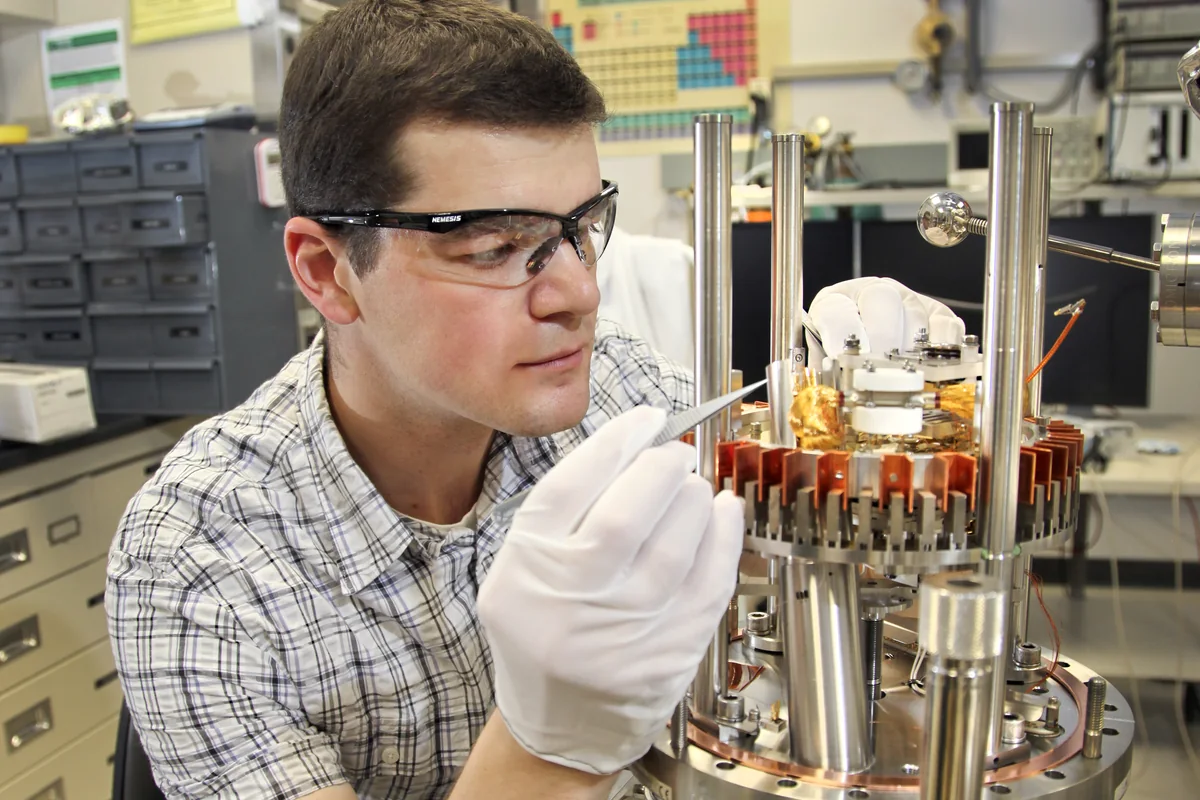
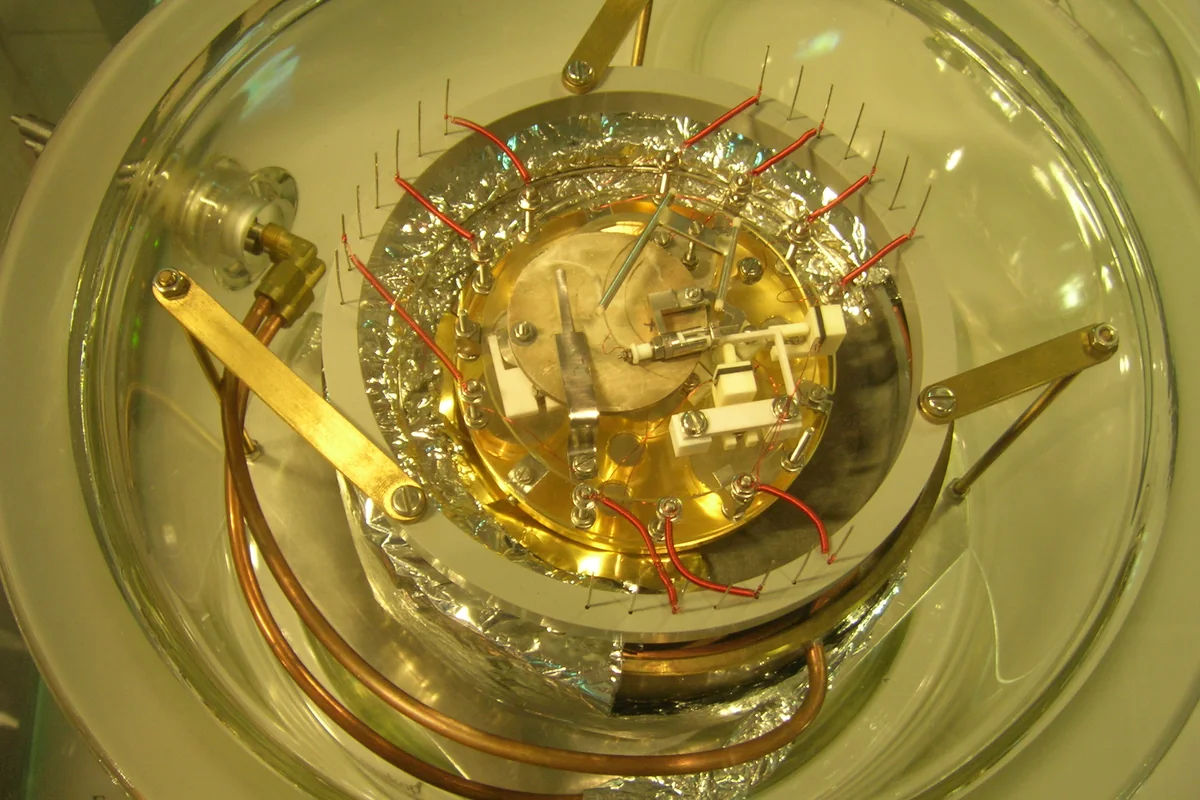
Mounting the molecule and watching it move fell to Oren Tal and Anil Kumar Singh, researchers at Israel's Weizmann Institute of Science. They positioned individual molecules across a junction formed by two gold tips, then stretched or squeezed the device by altering the gap. The apparatus ran at just 4.2 degrees above absolute zero.
The mechanism is almost intuitive: as electrons flow along the spiral, they hand their angular momentum to the molecule, exerting a twisting force that drives rotation, much like a stream of air spins a turbine. Whether the molecule turns one way or the other depends on whether its thread is right- or left-handed.
The control is what matters. Above a certain voltage threshold, motion shifts from stepwise jumping to continuous rotation; reverse the polarity and the direction reverses too. In other words, the direction is not fixed, it is dialed in with electricity.
But the finding that grabbed headlines was a surprise: while rotating, the molecule conducts electricity far better than at rest, rising by as much as a hundredfold. At rest the molecule tends to sit in certain configurations; rotation carries it through the geometries where conduction is easiest.
To pin down the mechanism, Fabian Pauly's group at the University of Augsburg, together with doctoral researchers Léon Martin and Yuta Ito, ran quantum-mechanical simulations on the LiCCA supercomputer. Martin described it well: the spots the molecule steers clear of while idle are exactly the ones that carry current most easily, and rotation is what unlocks them.
The theoretical framework was completed with Per Hedegård of the Niels Bohr Institute and Jing-Tao Lü of Huazhong University of Science and Technology. Calculation and experiment agreed: the molecule does transition from stepwise to continuous rotation, and the current surges with it.
The team also ran a control: a comparable straight molecule showed neither the characteristic cyclic electrical signal nor the dramatic conductivity jump. That points to the spiral's motion itself, not some other side effect, as the source of the boost.
Compared with the decade-old approach, the biggest difference is that this design is self-contained. Old motors needed a microscope tip to push them; this one hangs directly inside a live circuit, where electrons both drive the spin and get read by scientists. It behaves more like a tiny actuator that could drop into a circuit.
The prospects sound seductive: molecular-scale electronic switches, devices that exploit electron spin, even microscopic systems that manipulate fluids, could grow out of machines like this. It also gives scientists a new window onto how motion and electrical signals intertwine at the atomic scale.
The neat twist of the experiment is this: electricity makes matter move, and that motion in turn controls the electricity. Archimedes probably never imagined that his water-lifting screw would, two millennia later, spin again between two gold tips at the size of a single molecule.



Comments