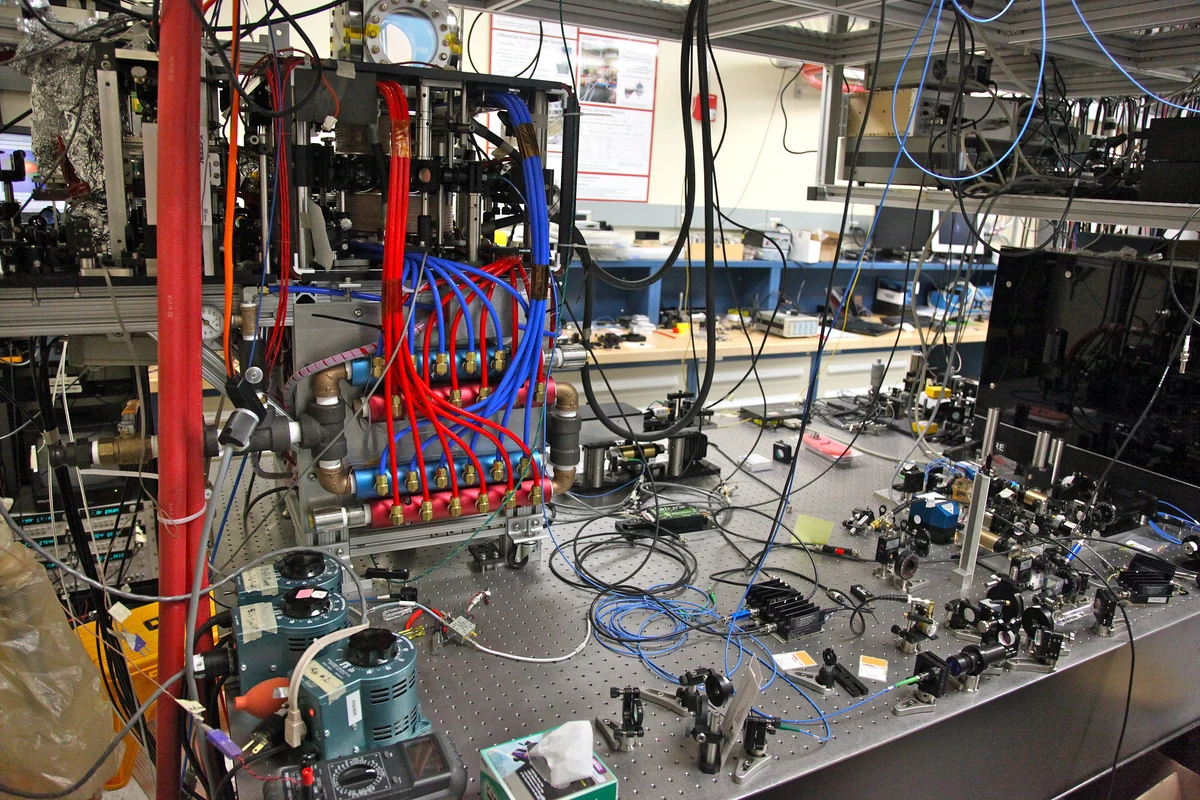
Put the number back into a human scale first. One picokelvin is a trillionth of a kelvin, so 9.7 picokelvin means this cloud of rubidium atoms sits just that far above the theoretical floor. Room temperature is roughly 300 kelvin. The ratio is too small to visualise, so a better translation is about speed: the atoms are moving so slowly that, for most practical purposes, they are nearly still, and their wave nature begins to dominate.
Why chase that kind of slowness? Temperature is, at bottom, a measure of how violently a collection of particles jitters. Fast atoms have short de Broglie wavelengths, quantum behaviour averages out, and what you observe is an ordinary gas. Slow them down and the wavelength stretches to scales of hundreds of micrometres; the matter waves of thousands of atoms begin to overlap and act in concert. That emergent, controllable quantum state is what low-temperature physicists are actually after.
The easiest detail to skip is the phrase seven seconds. Reaching an extreme temperature is hard; holding it long enough to run an experiment is harder. On the ground, gravity pulls cooled atoms downward, so they must be held in a tight trap. A tighter trap raises the achievable temperature floor and shortens the observation window. Microgravity in orbit dissolves that trade-off: atoms can float in an extremely shallow potential, cooling gets more efficient, and the window opens up.
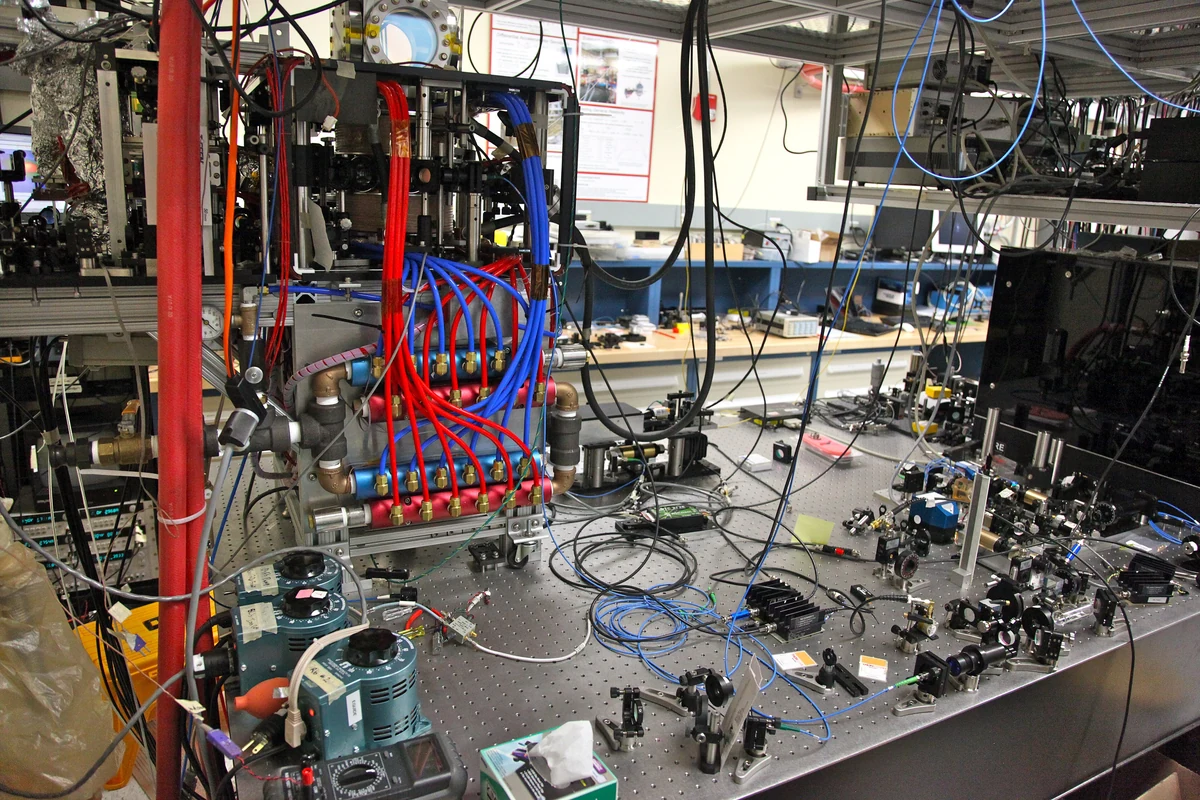
The technical route also diverges from the mainstream approach abroad. International groups often confine atoms in a microscopic magnetic trap formed on an atom chip and cool them by radio-frequency evaporation. This work uses an all-optical trap, with laser beams serving as the container. Optical traps make multi-beam control more tractable in space, shrug off magnetic interference, and accommodate a wider range of quantum simulation experiments. The price is complexity: beam alignment, frequency stabilisation and vacuum quality all have to stay stable without someone standing next to the apparatus.
Cooling happens in stages. A magneto-optical trap and optical molasses slow the rubidium vapour first, then a two-stage crossed optical dipole trap takes over. Lowering the light intensity drives evaporative cooling, letting the more energetic atoms escape so the average temperature of those left behind falls. A final non-adiabatic decompression step pushes it lower still. It reads like a recipe, but each parameter window is narrow, and every collision with a stray gas molecule ruins the run, which is why an extremely high vacuum is non-negotiable.

The engineering half deserves its own paragraph. The ground prototype occupied twenty cubic metres and weighed ten tonnes. The flight version fits in 0.7 cubic metres and half a tonne, roughly shrinking a small room into a household refrigerator. That is not simple miniaturisation: the ultra-high vacuum system, high-power fibre lasers, continuous long-term frequency locking and integrated optical bench all had to be redesigned, then survive launch vibration and years of unattended operation. From the initial study in 2011 to the cabinet reaching orbit in 2022 and this result in 2026, the arc spans fifteen years.
A fair question: moving the record from 38 picokelvin, set by a German team in 2021, to 9.7 picokelvin changes a table entry and what else? Ask it in reverse. What fits inside an observation window that has stretched from barely catchable to seven seconds? Phase transitions in quantum gases, non-equilibrium dynamics and many-body correlations — phenomena largely handled theoretically until now — can finally be watched frame by frame.
The applications share a single prerequisite. A colder, more coherent atomic cloud is a core resource for high-precision atomic clocks, and those clocks underpin navigation and time distribution networks. Atom interferometers measure gravity, rotation and acceleration finely enough to support gravimetric mapping and inertial navigation. Quantum simulation lets a controllable cloud stand in for models of the early universe or ultralight dark matter. Very different goals, all waiting on the same thing: get the atoms to sit still.
One clarification matters. The 9.7 picokelvin figure is an effective temperature, not a thermometer reading. It describes the momentum distribution inferred as the cloud expands, converted into a velocity scale. That is standard practice in ultracold physics, but headline shorthand tends to make it sound as though the entire apparatus was chilled to near absolute zero. Only a tiny cloud of atoms is cold; the hardware around it is not.

The third law of thermodynamics remains intact: absolute zero can be approached but never reached. So the point of a result like this is never that the finish line arrived, only that the explorable range extended one step downward. Historically, each new temperature regime has produced phenomena nobody predicted in advance. This one changed the environment as well as the temperature, which raises the odds of genuine surprises more than brute-force parameter tuning would.
It is also an unusual way of doing science. The apparatus stays in orbit, researchers operate it remotely from the ground, the orbital environment supplies one of the experimental conditions, and the data come back for analysis. It is neither purely theoretical nor the kind of bench work where you nudge a mirror between runs — it behaves more like shared space infrastructure. If that model holds up, similar fundamental-physics experiments become much easier to schedule.
For readers with no interest in quantum gases, the most concrete consequence sits in timing and measurement. Positioning, network synchronisation and grid dispatch all depend on exceptionally stable time references. Every order of magnitude gained in clock precision reshapes the error budget of systems built on top of it. None of that shows up in a shopping cart, which is precisely why it tends to be underrated.
Seven seconds is still a very short interval, and a single paper is not yet a mature platform. What comes next is repetition, the variety of experiments the cabinet can actually support, and whether microgravity can sustain longer coherence times. The record itself will be broken again; that is close to certain. The more interesting question is what physics can be read out of those seven seconds that cannot be read on the ground.
So this is better filed under experimental redesign than under records. A different location, a different way of holding atoms, a different optical and vacuum architecture — and only then one more digit after the decimal point. A lot of scientific progress comes not from pushing harder, but from quietly removing a constraint. This time the constraint removed was gravity.

Comments