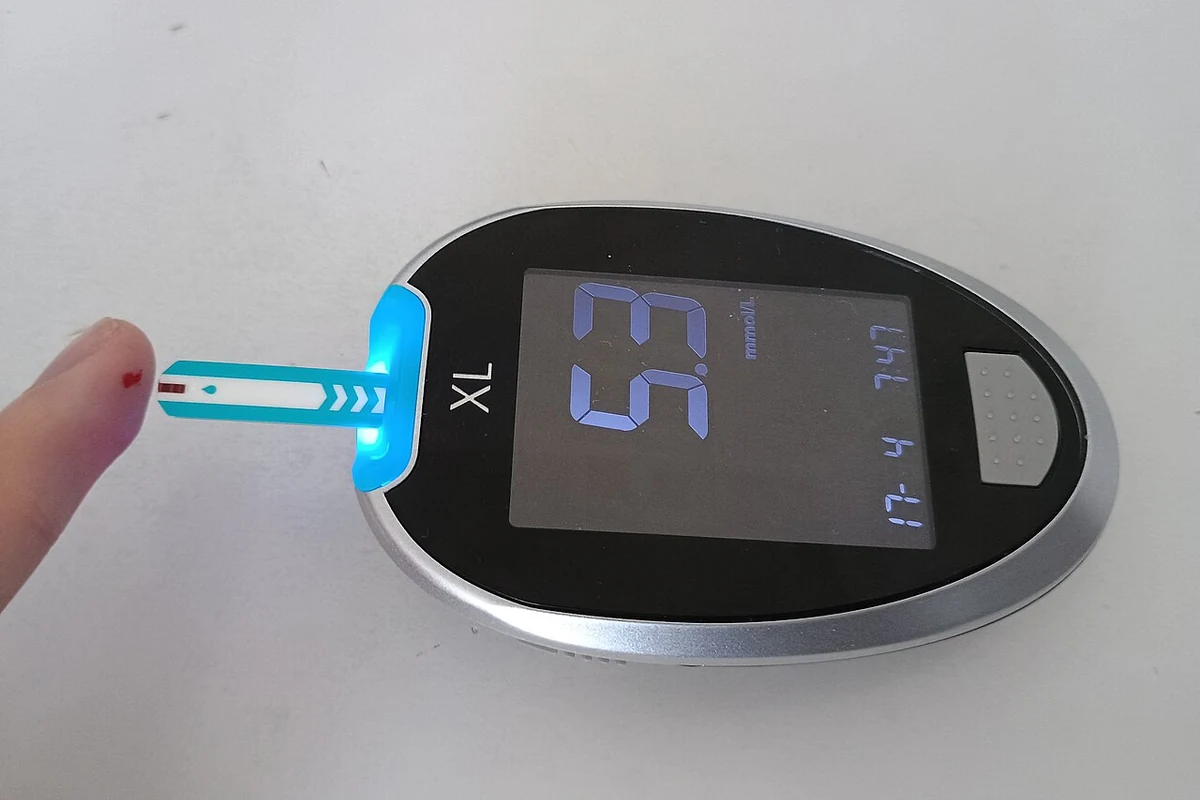
Finger-prick tests on a schedule, injections timed to the clock, meals counted in carbohydrates: the daily management of type 2 diabetes is built around tools that make decisions from outside the body. A study in Nature dated November 19 asks whether that premise can be flipped, by letting the body's own chemistry run the device instead.
Led by Yuxin Liu at the National University of Singapore and Lianhui Wang at Nanjing University of Posts and Telecommunications, the team built a soft implant called NeuroAxis, described as an artificial neuro-immune axis. It carries no battery, runs on glucose drawn from the blood, and stimulates the vagus nerve in a closed loop. In a rat model of type 2 diabetes, it brought blood sugar back close to healthy levels.
To see why the target was chosen, start with the vagus nerve.
The vagus nerve is a two-way trunk line between the brain and the internal organs. During a meal it carries signals up from the gut and issues instructions back to the pancreas to prompt insulin release. It also oversees an inflammatory reflex: when chronic inflammation is present, electrical stimulation of the nerve can dampen the release of inflammatory signals and ease the response.
Researchers have long known that stimulating this nerve can improve insulin sensitivity and even help protect insulin-producing cells. Type 2 diabetes tends to arrive bundled with obesity, insulin resistance and low-grade chronic inflammation, which land squarely on the three things this nerve helps regulate. The choice of target is not an accident.

Two stubborn limits have shaped the older hardware.
Conventional vagus nerve stimulators run into two problems that are hard to route around. The first is the battery and the rigid leads: they take up space, the charge eventually runs out, and swapping it means another operation. The second is open-loop control, which fires on a fixed program regardless of the current blood sugar.
The consequence of open loop is easy to picture. Once sugar is already back to normal, the device keeps stimulating, which can slow the heart rate or cause gastrointestinal discomfort. It behaves like a timed sprinkler that keeps watering long after the soil is wet, instead of one that pauses to read the moisture. The flaw is not the stimulation; it is that the hardware has no idea when to stop.
Put differently, the missing piece is awareness, not force. A large share of the past decade's iteration in implantable medical electronics has gone into supplying exactly that awareness, and closed-loop designs are the direction of travel.
The NeuroAxis answer is to take both power and judgment from the blood.
Its solution is neat: fit no battery at all, and use glucose in the bloodstream as fuel for self-power; at the same time, make the stimulation closed loop, so the device works only when sugar is high and rests once it returns to normal. Both the energy supply and the decision to fire are handed to the body's own chemical signals. The implant demotes itself to something closer to a reflex amplifier.
The experiment was deliberately plain. Diabetic rats were split into comparison groups. The group carrying a functioning NeuroAxis ate noticeably less, lost body weight, and carried relatively less abdominal fat, and these changes showed up before the blood-sugar numbers moved.
Timing is the sharper result. After just two weeks of treatment, that group's blood sugar fell to near the level of healthy rats, and its insulin resistance index dropped markedly. That second figure matters: it says the body regained sensitivity to its own insulin rather than being pushed down by an external force.
What the result means and what it does not are worth separating.
The most interesting part is not that sugar fell, but that self-regulation came back. Replacement-style therapy tends to see the problem return as soon as the intervention is withdrawn; a wake-up approach tries to get a circuit that already exists to work again. That is a genuine change in the design philosophy of a medical device. Self-power is not merely about saving a battery either. It merges 'where the energy comes from' with 'what the signal is' into a single variable, so the device is active by construction only when fuel is plentiful, which removes one layer of false triggering from the architecture.
The boundary has to be drawn just as firmly. This is a rat model, not a human trial. Long-term biocompatibility, the surgical burden of implantation, signal drift over time, and whether the power harvest scales to human dimensions all remain unanswered. The original reporting is explicitly framed as a professional reading of a paper and not as medical advice. So the accurate claim is that a direction for a new therapy has been lit up, not that a prescription has been delivered. For people who currently keep their sugar in range through outside intervention, the weight of that direction lies precisely in its ambition to hand control back to the body.


Comments