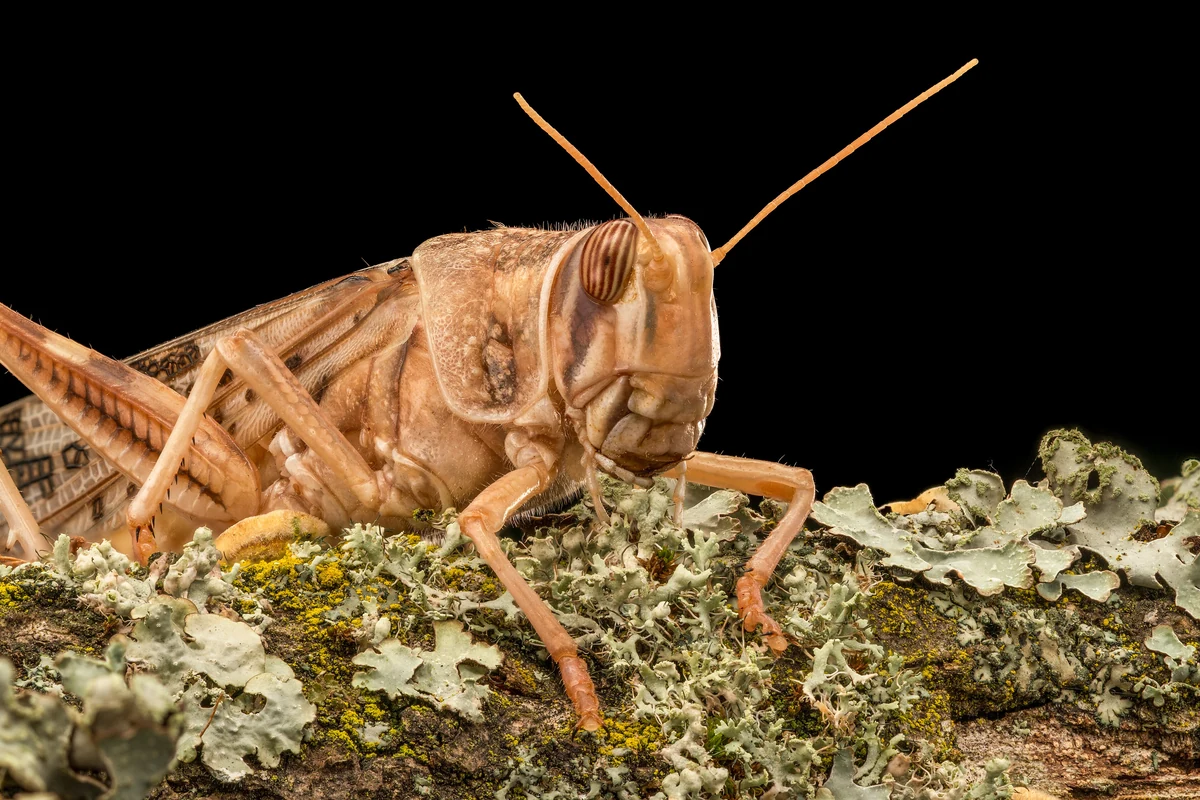
The most disturbing image in a locust outbreak is rarely the one of a field stripped to stubble. It is the moment the insects start eating one another. Cannibalism in migratory locusts is no occasional quirk; it is a variable that measurably shapes population density. Who gets injured, who gets eaten, and where a swarm moves are all tangled up with it. Yet for a behaviour that decides life and death, we have long had the phenomenon without a clear account of the signal behind it.
One half of the picture was fairly settled: gregarious locusts emit a protective odour that lowers their risk of being preyed upon by their own kind. That is a brake, essentially. The other half stayed blank. What odour actively summons nestmates to bite amounts to fitting the behaviour with an accelerator. With one half missing, any account of cannibalism remains half a diagram.
On 18 November a team from the Agricultural Genomics Institute at the Chinese Academy of Agricultural Sciences, publishing in Nature, supplied the missing half. Their most counter-intuitive claim is that the signal does not come from the insect at all. It comes from the symbiotic bacteria colonising its wounds. Once the sender changes from insect to microbe, the whole question has to be rephrased.
Using odour profiling, the researchers isolated the key volatile from the blend released by injured locusts: guaiacol. It is not synthesised by an insect gland but produced as a metabolite by bacteria enriched at the wound site. A damaged body begins to broadcast, in effect, because the microbes living on the lesion keep translating the local tissue state into chemical characters that a neighbour's antennae can read.
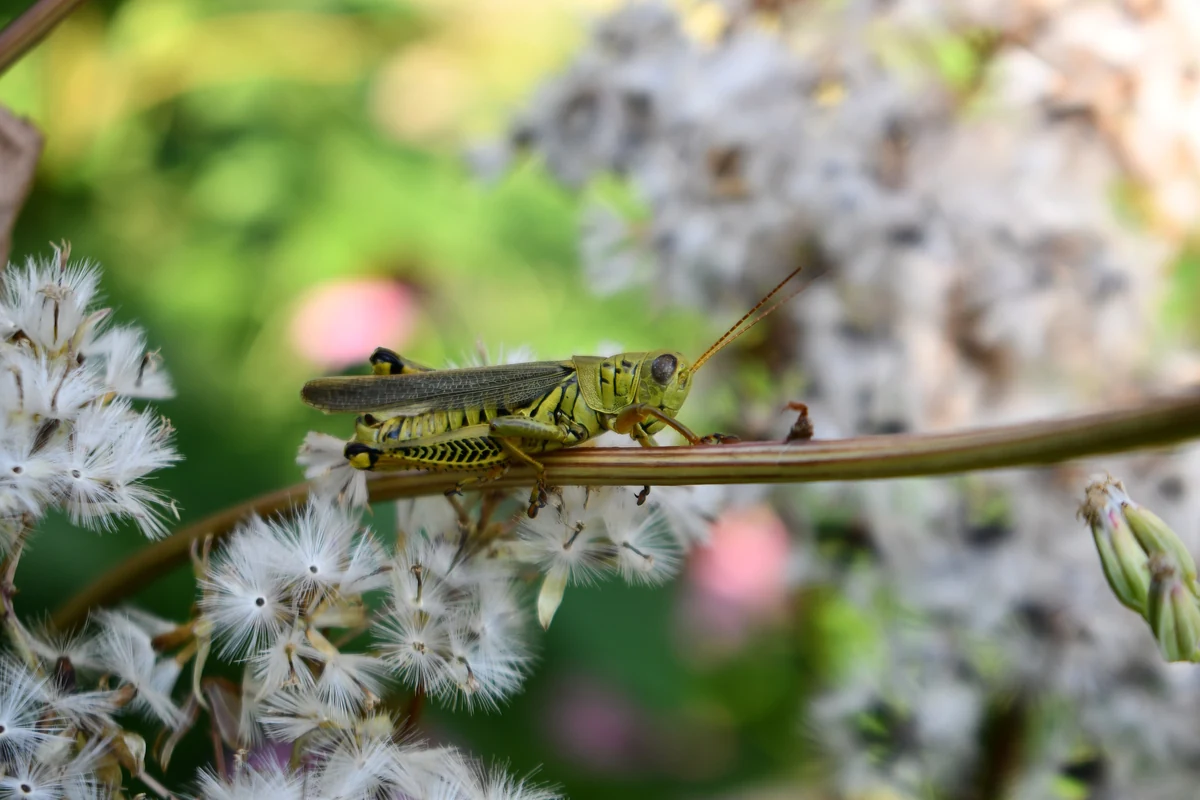
Finding a molecule is not enough; it is easy to stop at correlation. The team went further and identified two olfactory receptors that locusts use to sense guaiacol, then knocked out each in turn with gene editing. Remove either one and guaiacol no longer triggers cannibalism. That step moves the chain from A and B appear together to remove the middle link and the behaviour vanishes, which is where causation actually stands. Molecule, receptor, behaviour: three segments joined into one testable line.
The most absorbing detail is the bidirectional effect of concentration. At low doses guaiacol activates the injured locust's immune defences and raises its odds of survival. Once the concentration crosses a critical value, that identical molecule instead draws nestmates in to attack and feed. Rescue and killing are spelled with the same chemical characters; the fork sits only in the dose. A single signal with opposite outcomes is an uncommon design in chemical ecology.
I would read it as a threshold switch rather than as two substances at war. The system need not build a separate signal for protect and one for cull. It lets the intensity of one signal speak: a slight wound is worth saving; past a certain point, when the odour is too strong to mask, the individual becomes a burden and a resource to the group. A threshold converts a continuous injury into a discrete collective decision, and there is real elegance in that economy.
Why the bacteria do this is a matter of mechanism, not intent, and the paper is careful there. One cautious reading is that a wound is an entry point for infection and a leak of resources, so bacterial metabolism tracks the state of the lesion and concentration becomes an honest readout of how badly the insect is hurt. For a nestmate, following that readout is cheaper than probing each individual one by one. That is an ecological interpretation, not a claim that microbes designed the encounter on purpose.
Turn to application and the most concrete payoff is a shift in how pest control is framed. The traditional question is how to kill the insect. Once the specific molecule and receptor that trigger aggregation and cannibalism are known, a second route opens: manipulating behaviour. Synthetic analogues could serve as lures, receptor antagonists could jam the signal, and guaiacol itself could work as an odour marker for early monitoring. The more specific the target, the less the tool has to be a broad-spectrum insecticide.
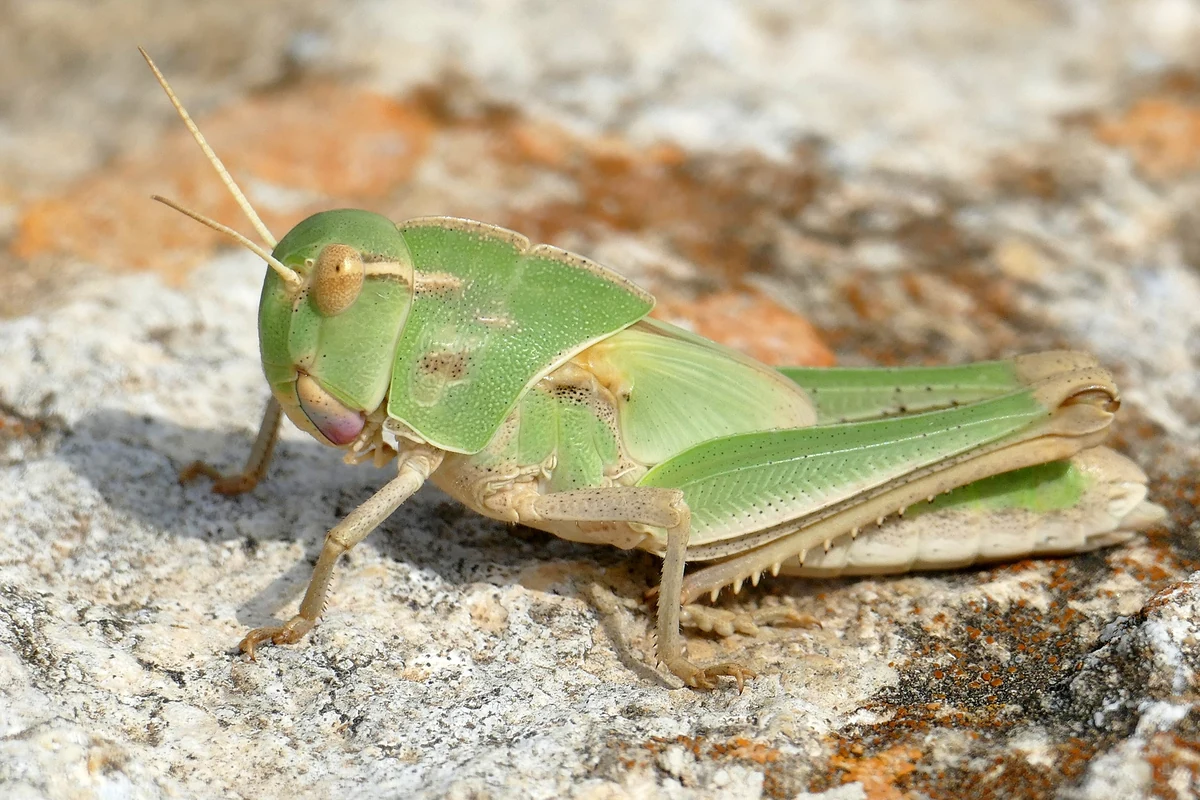
For managing outbreaks, early warning is often worth more than suppression after the fact. If the volatile profile shifts before a visible swarm forms, as populations move from solitary to gregarious and injured individuals start to appear in numbers, then sampling the air for characteristic molecules could pull the intervention window forward. Odour-based monitoring of this kind is cheap and continuous, and complements satellite imagery and field surveys rather than competing with them.
The tidy concentration gradient of the laboratory gets messy fast in a field. Wind, humidity, temperature, adsorption onto vegetation and background odours all smear a crisp threshold curve into a fuzzy band. A critical concentration that is exact in a dish is not necessarily the one that operates in an open wheat field. Between can trigger and can predict wild populations lies a whole campaign of environmental calibration.
Several questions also have to stay open. Whether this receptor-and-molecule relationship holds for other locust species and distant geographic populations, whether the two receptors are functionally redundant, and whether long-term disruption of the odour spills onto predators and non-target insects all remain unanswered. Once a chemical intervention enters an open ecosystem, side effects are usually harder to measure than efficacy.
So the real weight of this paper, to my mind, is that it promotes odour from a descriptive phrase into a complete loop of molecule, receptor, behaviour and dose, with gene editing as the reverse check. What basic research hands to application is never a ready-to-spray product but a set of testable, intervenable targets. Whether those targets become tools at the edge of a field depends on who next does the hard work of environmental calibration and ecological safety together.






Comments